


Naturalist Spotlight: Fish

/
By Rob Pudim
Here fishy, fishy…
It is not unusual in the James Peak and Indian Peaks Wilderness Areas (JP/IPWA) to meet people carrying fishing rods. After all, there are fish in the reservoirs, lakes and streams of the mountain riparian ecosystems. These ecosystems traverse a broad elevation range from tree-dominated elevations to shrub-tangled alpine bogs and tarns.
The fishing rod-toters, as I like to call them, are generally interested in catching game fish so they leave other fish alone such as:
the White Suckers (Catostoma commersoni),

Fathead Minnows (Pimephales promelas),

Johnny Darters (Etheostome nigrens),
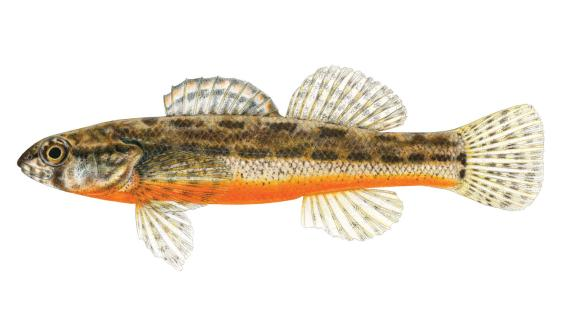
and freshwater Sculpins (Cattis ssp.) that are also common in the pools, creeks and lakes.

These small bottom-feeders however are great food for birds, mammals and larger fish.
In the Wilderness areas the larger game fish are trout; no bass, perch, pike or walleyes to be had. When I first came to Colorado I was told about fur-bearing trout in the high country. They said it was so cold there, trout needed hair to stay warm. I figured they were yarning me until one day I looked down into a brook and saw one scurrying through the water toward the bank! Really. Their real name is Water Shrew (Sorex pallustris), a voracious little package of appetite that will eat anything alive.
Okay, so there is no fur-bearing trout, but JP/IPWA have four non-native trout species that are hugely popular with anglers:
Rainbow Trout (Salmo giardneri)

Golden Trout (Salmo acquabonita) from the West Coast

Brook Trout (Salvelinus fontinatis) from the East Coast

Brown Trout (Salmo trutta) from the warm waters of Europe

Colorado Cutthroat Trout are the only native big fish.

Interesting Trout Facts
The greenback cutthroat trout is widely considered the rarest and most special trout to find in Colorado. Declared extinct in 1937, it was later rediscovered in small numbers. As the official state fish, catching a genetically pure native greenback in its restored high-altitude waters is a rare milestone for anglers. - https://cpw.state.co.us/species/greenback-cutthroat-trout
Colorado Parks and Wildlife (CPW) occasionally maintains select high-altitude fisheries in the Indian Peaks Wilderness via specialized aerial stocking, using single-engine airplanes to drop tiny trout fingerlings into remote alpine lakes. However, many of the 33 fish-containing lakes in the wilderness rely on self-sustaining, naturally reproducing trout populations rather than active, recurring stocking. [1, 2, 3, 4]
Fishing in the high-country can be joyous or disappointing. Often you can see them but they just don't bite. They do not feed all the time. When they are eating, they will go after something as simple as a piece of down from your jacket. When they are not eating, forget worms, grasshoppers, flashy spoons, crickets or elk hair caddis flies. Nothing works. Then again, I haven't tried a trident or a big club or tickling them.
Naturalist column exploring high country flora, fauna and geography
IPWA volunteers are often asked by visitors not just about the trails, but about what they are seeing in the Indian Peaks and James Peak Wilderness Areas. This column will cover some of the plants, animals and geographic features that hikers, anglers and backpackers may come across in these areas.

About Rob Pudim
A long time Boulder resident, Rob describes himself as “a coal-miner's son from Pennsylvania, a "fallen" scientist (Chemistry, Rutgers University and Microbiology, Tulane University) an editorial cartoonist, an amateur lepidopterist, a Native Plant Master, and a long-time birder”. His affiliation with IPWA goes back to its founding in the 1980s.


Comments