


Why Like Lichens?

By Rob Pudim
“Lichens are fabulously interesting. They are a little like a three-layer cookie. The outer layer is a fungus, the middle layer is either a green or blue-green algae, and the lower layer helps it adhere to whatever surface it’s on. And lichens can grow on nearly any surface, even some you’d never think of: rocks, trees, soils, even glass, metal, an insect or two and one species of tortoise.” Boulder County Parks and Open Space

Lichens can be found everywhere in the Wildernesses. As a matter of fact, it can be found everywhere on Earth. It has been around a long time. How many colors of lichen have you seen?
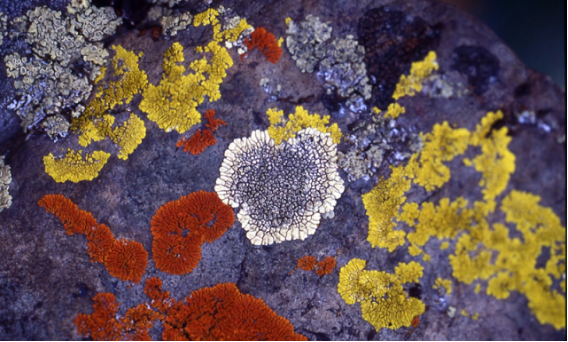
Lichens look like scabs on a rock and have many colors--black, gray, brown, tan, yellow, red, green. They grows not only on rock but also tree bark, rotting wood, and soil. Lichens are fundamental colonizers of bare rock and can actually live inside of solid stone. Some others, called epiphytes, need only air and dust to thrive. Most of them cling to rock with rootlike rhizines.
Fun Fact: Lichens carry their own food with them. They can reproduce sexually, asexually or both. Some lichens can live up to 4,000 years.
Lichens are a community composed of fungi, algae and bacteria. Recent research suggests it may even be more complicated than this and include yeasts (ascomycetes, basidiomycetes and basidiomycetic). The fungi in the community supplies a structure for the constituents, keeps it from drying out and donates needed minerals. The algae are imbedded in the fungus and absorb sunlight and give the others its surplus glucose. Cyanobacteria and other bacteria do the same thing and also produce substances to kill things which would harm the fungi and algae.
The result of this symbiosis is rock is turned into soil which plants need. The rhyzines exude vulpmic and usnic acid that slowly dissolves rock and allows the lichens to grow about a millimeter a year. Without billions of years of lichens, there would be no life on Earth except in the ocean.

Lichens are food for reindeer and are also eaten by humans, birds, snails, nematodes, mites and springtails. Some Lichens are toxic and almost all the yellow lichens are poisonous. In Iceland lichens are boiled and constitute what they call rock soup. Some other lichens are mildly hallucinogenic.
According the the US Forest Service, “One of the ways lichens directly benefit humans is through their ability to absorb everything in their atmosphere, especially pollutants.
Lichens can provide us with valuable information about the environment around us. Any heavy metals or carbon or sulfur or other pollutants in the atmosphere are absorbed into the lichen thallus. Scientists can extract these toxins and determine the levels that are present in our atmosphere. The United States Forest Service National Lichens & Air Quality Database and Clearinghouse provides more information about lichen biomonitoring and how it is helping federal land managers meet federal and agency responsibilities to detect, map, evaluate trends, and assess the ecological impacts of air pollutants.” (https://www.fs.usda.gov/wildflowers/beauty/lichens/about.shtml)
There are at least 20,000 species of catalogued lichens and more to be discovered and described. Lichens may well be one of the oldest continuous living things on Earth.

My best guess is that there are more species of lichen in the Indian Peaks Wilderness than any other living thing there. My favorite memory connected with lichens is being prone on the tundra on Mt. Blue Sky (Mt. Evans) with a few other nerds, a book in one hand and magnifying glass in the other, nose almost touching the rocks, and being approached by some tourists who thought we had fainted because of the altitude!
For more photos of lichens check out the Colorado Native Plants society photo gallery at https://conps.org/lichens/
Naturalist column exploring high country flora, fauna and geography
IPWA volunteers are often asked by visitors not just about the trails, but about what they are seeing in the Indian Peaks and James Peak Wilderness Areas. This column will cover some of the plants, animals and geographic features that hikers, anglers and backpackers may come across in these areas.
About Rob Pudim

A long time Boulder resident, Rob describes himself as “a coal-miner's son from Pennsylvania, a "fallen" scientist (Chemistry, Rutgers University and Microbiology, Tulane University) an editorial cartoonist, an amateur lepidopterist, a Native Plant Master, and a long-time birder”. His affiliation with IPWA goes back to its founding in the 1980s.


Comments